 Feishu
×
Larkway
Open source · MIT
Feishu
×
Larkway
Open source · MIT
Bring Claude Code / Codex
into Feishu. Let the whole company @ it.
An engineer defines once what the agent may do. Teammates @ it in a Feishu group with one sentence; it runs on the local machine and posts the result back.
 @ in Feishu
→
Local Claude Code / Codex runs it
→
Result back to the group
@ in Feishu
→
Local Claude Code / Codex runs it
→
Result back to the group
 Codex
Gemini Coming soon
Codex
Gemini Coming soon
Not one agent —
define as many as you need.
Each agent has its own role, the material it may access, and its engine. An engineer defines it once; whoever the team @s in Feishu shows up and does the work.
Edits campaign landing pages, tweaks styles, spins up preview links.
Reviews PRs, runs tests, suggests changes.
Answers "how does this feature work?" without touching code.
CodexChecks monitors, pulls logs, pinpoints incidents first.
CodexSummarises core metrics every Monday and posts to the ops group.
Once defined,
the whole team can @ it.
Product, ops and data each @ the agent they need in Feishu — no more queueing to interrupt an engineer.

Product PM
Draft a PRD, digest user research, break down requirements — in one sentence.

Operations Ops
Query monitors, pull logs, generate campaign reports, locate issues first.

Data DS
Pull, clean, model, visualise — results land straight in the group.
Feishu is the entry point. Your machine does the work.
Transparent and auditable end to end — code and credentials never leave the machine, no API key is injected, your existing subscription login is reused.
Define the agent
An engineer sets its role, boundaries, and which repos, material and workflows it may touch.
@ in Feishu
A teammate states the request in plain language — no terminal, no process to learn.
Runs locally
Claude Code / Codex runs on the engineer's machine with the real context.
Back to the group
Answers, preview links, progress and files are posted back to Feishu — previewable, reusable.
Open source, subscription auth,
runs on your own machine.
Code and credentials are never handed to a cloud service. Your existing Claude Code / Codex subscription is the auth; no extra tokens to buy.
Open and auditable
All code is public, PRs welcome. Safe enough to let it touch local code.
Subscription auth
Reuses your local subscription login — no injected API key, no extra tokens.
Local execution
Code and credentials stay on the host; nothing passes through a third-party cloud.
Multiple engines
Pick Claude Code or Codex per bot; more engines can be added smoothly.
A few commands, on your own machine.
Once the host is running, the team can @ it in Feishu. Current line: v0.3.x = Agent Workspace Runtime.
# install globally
$ npm i -g larkway
# check environment / subscription login
$ larkway doctor
$ larkway init
# start the bridge; the team can now @ it in Feishu
$ larkway start
✓ bridge online · Feishu connected
The questions we get asked most.
What is Larkway?
An open-source (MIT) thin bridge that turns your locally logged-in Claude Code or Codex into a Feishu (Lark) agent your whole team can @-mention. Feishu is the entry point, Larkway is the bridge, Claude Code / Codex is the engine.
Do I need an API key?
No. Larkway reuses your local Claude Code / Codex subscription login. It never injects an API key and you do not buy extra tokens.
Does my code get uploaded anywhere?
No. The agent runs on your own machine. Code and credentials stay local; only messages and cards travel between Larkway and Feishu.
Do I need a public IP or open ports?
No. Feishu pushes events over a persistent WebSocket; outbound access is enough.
Can non-engineers use it?
Yes. An engineer defines a bot once (permissions, role, which repo); product, ops and data teammates @ it directly in Feishu.
Can I use it from my phone?
Yes. @ the bot from the Feishu mobile app; the agent runs on your computer. See the post on dispatching a fleet of local agents from your phone.
Join the Larkway group on Feishu.
Setups, rough edges, how to shape agents for your team — discussed and solved together. Mostly Chinese-speaking; English is welcome, or open an issue on GitHub.
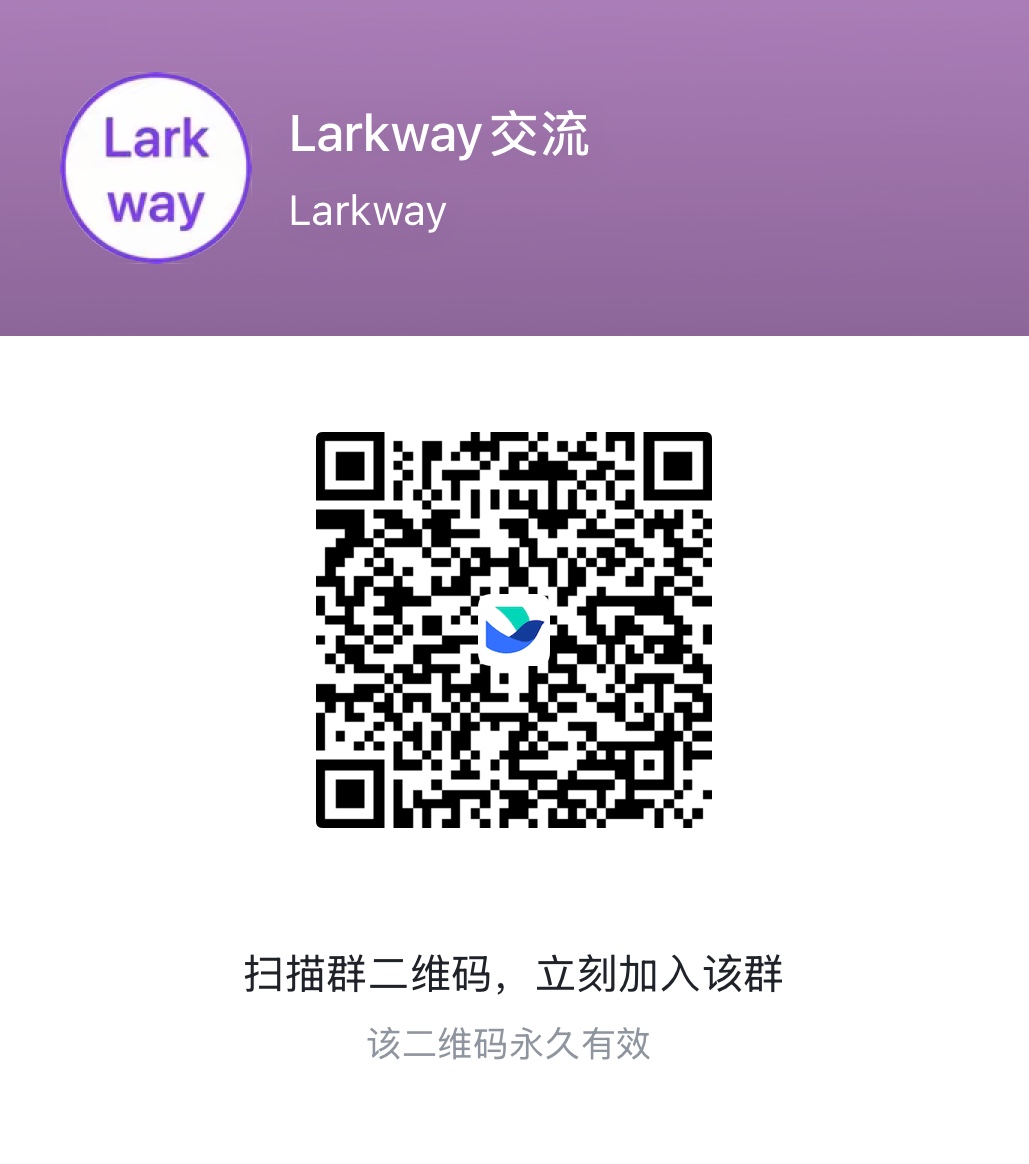 Scan with Feishu · QR never expires